
In brief
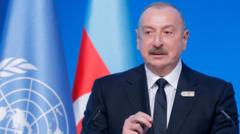
Azerbaijan's President Ilham Aliyev declares oil and gas a "gift of god," while UN leaders call for urgent action against climate repercussions.
In a lively discourse at the COP29 climate conference, Azerbaijan's President Ilham Aliyev boldly proclaimed that oil and gas should not be seen as a liability but a "gift of god." His remarks aimed at pushing back against what he termed "Western fake news" surrounding his country's emissions and natural resource usage. This defiance comes as Azerbaijan aims to boost its gas production by one-third over the next decade, a move that has attracted scrutiny from global observers.UN Secretary-General António Guterres did not mince words, emphasizing the absurdity of continuing reliance on fossil fuels. He heralded the arrival of a "clean energy revolution" that no government could halt. The UK Prime Minister, Sir Keir Starmer, leveraged the momentum by announcing a new target aiming for an 81% reduction in emissions by 2035, urging other nations to rise to the challenge.However, the COP29 hosting raises eyebrows due to the Azerbaijani minister for ecology and natural resources being a former oil executive. Concerns linger that the conference could serve as a platform to attract investment into Azerbaijan’s state-run oil and gas operations. Aliyev maintained his defense, stating that the global share of Azerbaijan's gas emissions is a mere 0.1%, downplaying the international criticism.Amidst the backdrop of key figures, such as U.S. President Joe Biden’s envoy John Podesta, who criticized the incoming Trump administration's climate stance, the discussion took a global dimension. Guterres issued a dire warning: "The ticking clock" signals urgency in limiting global temperature rise to 1.5 degrees Celsius, with 2024 potentially becoming the hottest year recorded.Developing nations are pressing for significant financial support, calling for a collective fund potentially worth $1 trillion from higher-emission countries. With key leaders absent from the conference, the likelihood of reaching a unanimous agreement remains uncertain. In this critical moment in climate discussions, the dichotomy of perspectives serves to illuminate the complex and often contentious relationship between natural resources, economic growth, and environmental responsibility.

