
In brief
Typhoon Noul’s arrival has triggered floods and emergency evacuations across China, but a new threat—AI‑generated fake videos—has amplified the crisis. Social media is flooded with doctored footage depicting dead bodies, false flooding scenes and staged rescues, prompting panic buying and distrust in official reports. The Cyberspace Administration, along with local police, has launched a nationwide crackdown on misinformation and urged platforms to tighten content review, while experts warn that AI tools lower the barrier for creating convincing propaganda. China’s rapid investment in AI technology threatens to outpace legal frameworks, risking widespread misinformation during emergencies.
Typhoon Noul made landfall over China’s eastern coast last weekend, unleashing flash floods that forced mass evacuations and damaged infrastructure. As emergency officials struggled to manage rescue operations, a wave of AI‑generated hoax videos began circulating on social media.
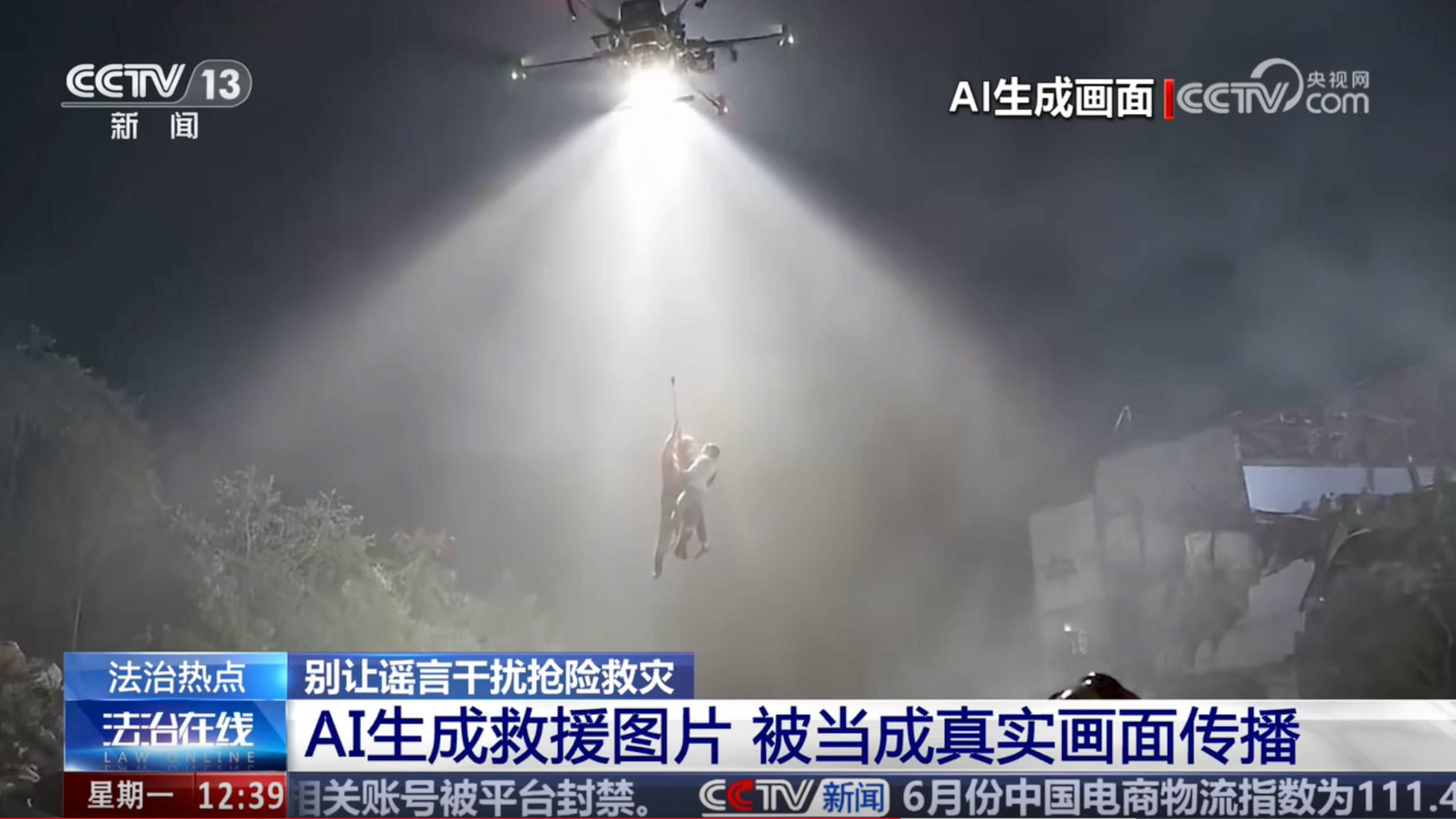
The doctored footage ranged from images of dead bodies floating in floodwater to staged scenes of rescue teams prioritising pigs over people, but identified by the Beijing Rescuers label as “AI‑generated.” Such videos have convinced residents to panic‑buy emergency supplies, and in some cases triggered violent reaction incidents.
An official spokesperson, Huang Zhihua of Zhejiang Police, warned that creators of these videos deliberately spread sensationalised content to attract views. He noted that arrests and fines have followed recent cases of misinformation, but the high volume of content makes law‑enforcement challenging.
Academic voices highlight how AI lowers technical barriers to fabricating convincing media. Professor Chen Bin explained that a simple prompt to an AI model can generate text, images or videos that appear authentic, yet are entirely fabricated. While experts call for clear “AI watermark” labeling, they also note that savvy users can strip such marks, rendering a blanket solution ineffective.
The authorities’ response has been swift. On 23 July, China’s Cyberspace Administration ordered a nationwide clampdown on fake content related to floods and other disasters, instructing local branches to address fabricated data, staged scenes and impersonations. The campaign also urges social media platforms to strengthen review mechanisms and not host unverified content.
Despite these measures, scholars warn that AI misinformation will outpace legal frameworks. Peter Pang, a lawyer based in Shanghai and Washington, argues that platforms and app developers must share legal liability for the spread of dangerous content. He cited a hypothetical case where a panic‑inducing post led to a traffic collision, asserting that creators of the original content created the underlying panic that caused real‑world harm.
China is already investing billions in AI research, maintaining its aim to become a global tech superpower. With over 6,000 AI companies in the country, university professors urge the establishment of “trusted information infrastructure” that offers real‑time early warning systems and reliable disaster interfaces for media outlets.
In the long term, experts agree that the intersection of AI, social media, and disaster response demands proactive policy and public education. Without pre‑emptive safeguards, subsequent natural disasters, elections, or health crises could become breeding grounds for high‑risk misinformation. The current crackdown, if coupled with technologically advanced detection tools and regulatory clarity, may be the first step toward protecting citizens in a hyper‑connected world.
