
In brief
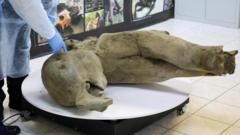
The remains of a well-preserved baby mammoth, estimated to be around 50,000 years old, have been unearthed in Siberia, marking a significant discovery in paleontology. Named Yana after her discovery site, this remarkable find showcases the impacts of climate change on ancient ecosystems.
In a stunning revelation, Russian scientists have unveiled the remains of a remarkably well-preserved baby mammoth, believed to be about 50,000 years old, discovered in the thawing permafrost of Yakutia, Siberia. The mammoth, affectionately named "Yana" after the river basin where she was found, is being lauded as the most intact specimen of its kind ever located.Yana, which weighs over 100kg (15st 10lb) and measures around 120cm (4ft) in height and 200cm in length, is thought to have been roughly one year old during her demise. This groundbreaking discovery, made during the summer months, adds to a rare collection of such finds, which previously numbered only six worldwide, primarily in Russia and one instance in Canada.The remains were located in the Batagaika crater, recognized as the largest permafrost crater globally. Local residents inadvertently stumbled upon Yana as the thawing process revealed her nearly complete remains. Maxim Cherpasov, head of the Lazarev Mammoth Museum Laboratory, noted that the villagers fashioned a makeshift stretcher to recover the carcass as it emerged from the ice. While some of the mammoth's forelimbs showed signs of predation, the head remains in astonishing condition. Cherpasov speculated that Yana may have fallen victim to a swamp, explaining her fossilization over millennia. Fresh investigations are currently underway at North-Eastern Federal University in Yakutsk to pinpoint the exact date of her death.This find is not an isolated occurrence; Siberia's thawing landscape has recently revealed other prehistoric marvels, including a mummified sabre-tooth cat, nearly 32,000 years old, and a wolf, aged 44,000 years. These discoveries, spurred by climate change, continue to enhance our understanding of ancient life forms and their environments.
