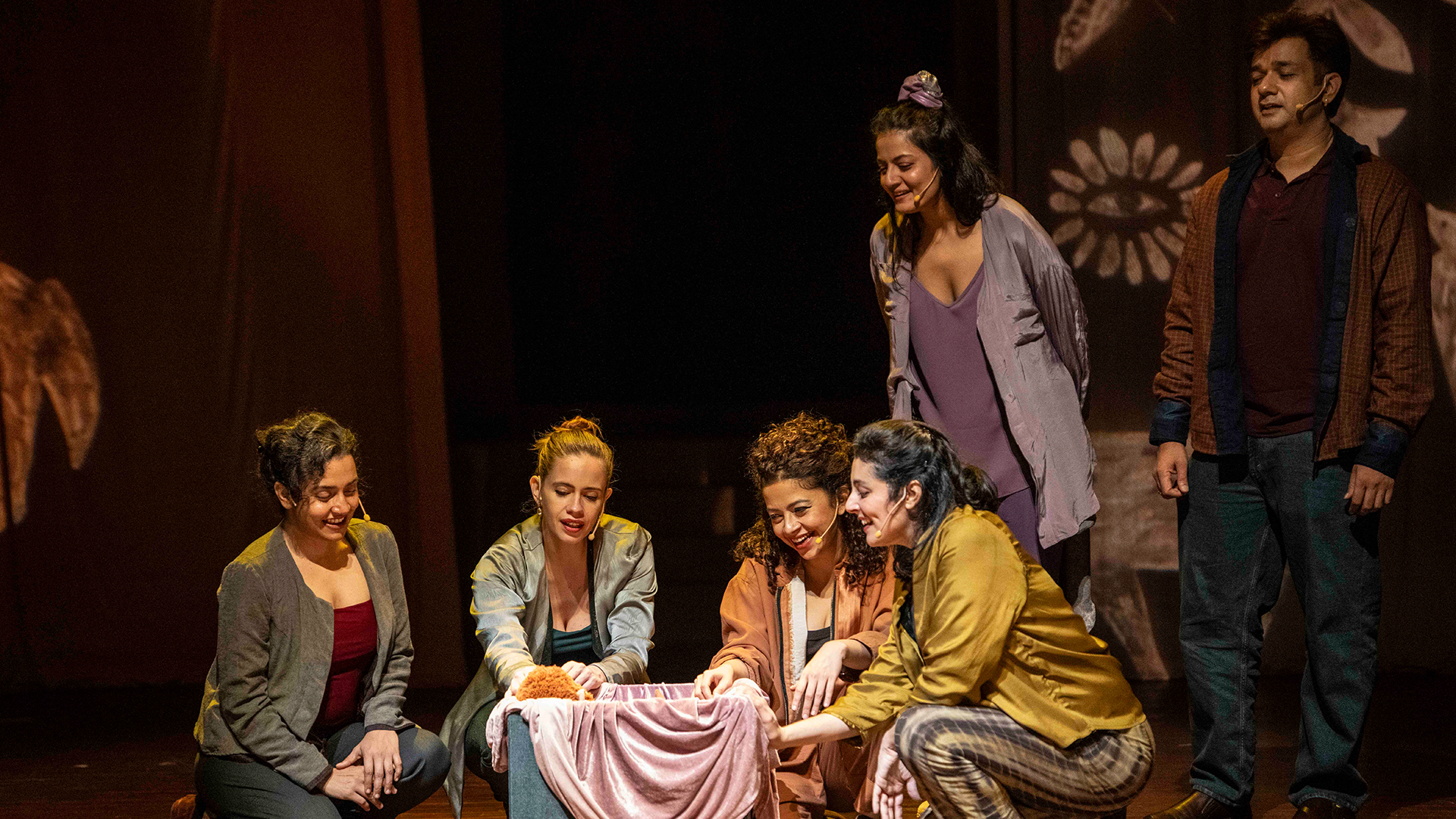
The birth of a baby is celebrated as a moment of joy, yet motherhood is not always warm and fuzzy. Belly of the Beast—directed by Sheena Khalid and based on Kalki Koechlin’s 2021 book The Elephant in the Womb—shows the messy, untidy side of parenthood.
The play follows five women in differing stages of motherhood, from pregnancy and labor to raising young children, and confronts difficult topics such as abortion, miscarriage and postpartum depression.
In a society where motherhood is seen as a sacred duty, the play’s candidness about the challenges many women face is refreshing. Koechlin explained that she wrote the book during a COVID‑lockdown period when she was battling postpartum depression and felt isolated, making it cathartic to share her experience.
After the lockdown, she met mothers whose stories echoed her own— the universal struggles that every woman can relate to— and wanted to render those into the stage narrative.
At its recent premiere in Delhi, a standing ovation followed the finish of the half‑two‑hour‑ten‑minute play. The mixture of hard-hitting themes with humour helped audiences engage without feeling overwhelmed.
One of the play’s strongest points is its treatment of miscarriage. In a country as large as India, losing a baby carries heavy social stigma, and the play highlights that beyond grief there is shame and pity that often goes unspoken.
Author Shruti Vyas, who portrays a young woman who has suffered a miscarriage, reflects her personal experience. She shares that people often say, “you don’t look like you’ve had a miscarriage,” and she claims this demonstrates a lack of understanding about the timing of grief.
By voicing this reality, the play invites audiences to realise that it is adequate to feel pain, and that acknowledging it is not a sign of weakness.
In the conversation about motherhood in India, women are seldom allowed to discuss the darker feelings, hormonal changes, identity loss and depression that come with the role. Koechlin illustrated that “we are told we’re lucky to be mothers, yet the reality transforms us, and we experience grief, losing part of our former selves.”
The production also highlights how childcare and housework keep around 69% of urban Indian women out of the labour force, while only 1% of men are affected, according to the Times of India. It emphasises that despite modern advances, society still expects women to be “supermoms” and constantly be the CEOs of the house.