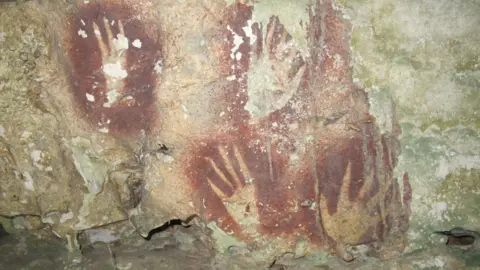
A stencilled outline of a hand found on the Indonesian island of Sulawesi is now recognized as the world's oldest known cave painting. This remarkable artwork, which features a red claw-like motif, has been dated to at least 67,800 years ago, making it at least 1,100 years older than the previous record-holder, a hand stencil believed to be from Spain.
The discovery supports the hypothesis that Homo sapiens had reached the wider Australia–New Guinea landmass, known as Sahul, significantly earlier than previously thought. The implications of this finding are profound; it suggests that the artistic abilities and abstract thinking of our species were not confined to Europe, contradicting long-held beliefs of a creative explosion originating there.
Over the last decade, discoveries on Sulawesi have redefined our understanding of prehistoric art and cognitive development. Early forms of cave art are crucial indicators of when human beings began to engage in complex symbolic thought, a hallmark of our species that also relates to language, religion, and science.
Professor Adam Brumm from Griffith University, a co-lead on the project, shared insights claiming that this find illustrates the continuity of creativity among ancient humans and indicates that cultural practices such as these were widespread across regions, not limited to isolated occurrences.
As cave art provides crucial insights into human cognitive evolution, this discovery in Sulawesi may reshape the narrative of our species' migration and artistic expression, suggesting the capacity for such creativity has its roots deep within our collective history, reaching back well before we ventured out of Africa.