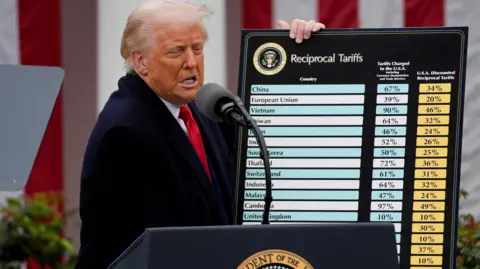
President Donald Trump's use of sweeping tariffs faced sharp questioning at the Supreme Court on Wednesday, in a case with major implications for the president's agenda and the global economy.
A majority of justices, including several conservatives, expressed doubts about the White House's justification of the import duties, which the president has said are necessary to restore America's manufacturing base and fix its trade imbalance.
The measures are being challenged by a number of small businesses and a group of states, which contend that the president has overstepped his authority in imposing the levies, which are in effect a tax.
America's top court - which has a 6-3 conservative majority - usually takes months to reach big decisions, but many expect it to move faster in this case, seen as the first major test of the Trump administration's push to expand presidential power.
Supreme Court Justice Amy Coney Barrett questioned the rationale behind imposing tariffs on countries like Spain and France, indicating skepticism about the broad application of tariffs. The stakes are high; billions of dollars in tariff payments hang in the balance, and a ruling against the Trump administration could require refunds of collected tariffs.
The court's conservatives are wrestling with the implications of allowing such executive power, with Chief Justice John Roberts highlighting the potential for unchecked presidential authority in imposing tariffs.
The case revolves around the International Emergency Economic Powers Act (IEEPA), which grants the president certain powers in times of crisis. This controversial use of presidential power to impose tariffs on a wide array of products has sparked significant debate, particularly regarding its constitutionality and potential economic consequences.
The evolving situation has drawn the attention of small business owners like Sarah Wells, who has faced significant financial hurdles due to the tariffs. As the court considers the arguments, the outcome remains uncertain, illustrating a critical moment in the intersection of law, economics, and presidential authority.