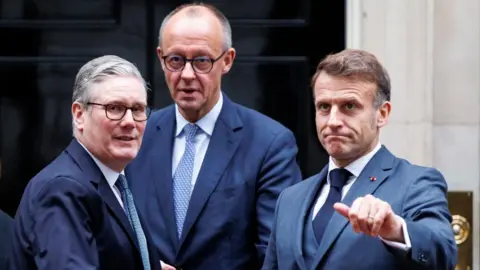
German Chancellor Friedrich Merz has announced that Ukraine has presented a new draft of its peace plan to US President Donald Trump, which includes considerations for territorial concessions that Kyiv may be willing to entertain.
Merkz emphasized that the matter of territorial concessions is fundamentally a concern for the Ukrainian president and its people. We also made this clear to President Trump, he asserted during discussions.
In recent weeks, European leaders have collaborated with Ukraine to formulate a proposal that reflects Kyiv's interests and reservations about the ongoing conflict with Russia.
As discussions continue, Trump's exasperation with the complexities regarding territorial sovereignty in Russian-occupied regions is evident. Consequently, Ukraine's allies are apprehensive that he might advocate for a resolution favoring Russian terms.
It would be a mistake to force the Ukrainian president into a peace that his people will not accept after years of suffering and loss, warned Merz, following a joint news briefing with NATO's chief, Mark Rutte.
During a recent phone call, Merz, along with French President Emmanuel Macron and UK Prime Minister Sir Keir Starmer, made it clear to Trump that European perspectives must be taken into consideration.
Despite expressing willingness to speak directly with Trump, Ukrainian President Volodymyr Zelensky has stated that all issues must be resolved prior to any meetings with the US president. The territorial disputes remain obdurate, with Russia demanding Ukraine's complete withdrawal from Luhansk and Donetsk regions— a proposition Kyiv staunchly rejects.
We have no legal right to [cede territory], under Ukrainian law, our constitution and international law, Zelensky articulated. And we don't have any moral right either.
Zelensky is scheduled to engage in further negotiations today with his European partners as they strive to unify their positions.
While diplomatic maneuvering intensifies amongst US, European, and Ukrainian officials, Russia has exhibited a notable restraint in public communication on the ongoing negotiations, opting to portray alignment with the US regarding peace settlement expectations.
Foreign Minister Sergei Lavrov commended Trump's efforts in mediating a peace deal and remarked that a recent meeting with US emissary Steve Witkoff had resolved misunderstandings that arose during the previous Trump-Putin summit.
Ukraine and its allies demand robust security assurances, suggesting that any peace agreement lacking such guarantees could prove meaningless. Confidence is low, given earlier violations of ceasefire agreements by Russia, making the need for US involvement in future guarantees paramount.
As Zelensky hints at the potential for national elections contingent upon robust security measures, NATO's Rutte has emphasized the urgency of addressing the Russian threat, reminding that Europe could be the next target of aggression.