In brief
Denmark has experienced an alarming surge of drone activities near airports and military bases, crystallizing fears about the nation's exposure to hybrid warfare. Defense Minister Troels Lund Poulsen described the coordinated incidents as indicative of a 'hybrid attack', emphasizing that a professional actor is likely behind these incursions. With nearby nations like Poland and Estonia already on high alert due to similar threats, Denmark is assessing its military response while tackling public concerns regarding safety and security.
Drone incidents at airports and military bases all over Jutland, western Denmark, have not caused any harm or damage - and yet they have exposed the country's defences as vulnerable to attack.
In an era of hybrid warfare, there is a sense of embarrassment in Denmark - a founding member of the North Atlantic Treaty Organization (Nato) alliance - that its critical infrastructure has become so vulnerable.
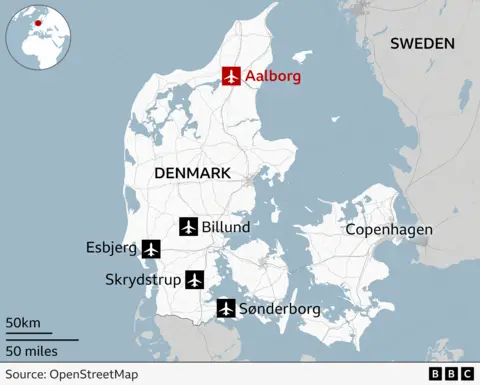
Aalborg and Billund airports had to close on Wednesday night, while drones were spotted at Esbjerg, Sonderborg, and Skrydstrup. Aalborg also serves as a military base and Skrydstrup is home to some of the air force's F-35 and F-16 war planes. Drones were also seen over the Jutland Dragoon regiment at Holstebro.
There have since been reports of police investigating drone activities around Denmark's oil and gas platforms in the North Sea, and near the central port of Korsor.
Aalborg airport briefly closed again on Thursday night following another suspected drone sighting, police and national media reported.
The question now facing the country's military is how to respond.
None of the drones have been shot down - defence chiefs decided it was safer not to, but that is not a long-term solution.
Denmark is, of course, not alone. Norway, Estonia, Poland, Bulgaria, and Romania have all been subjected to hybrid warfare in recent weeks, with Estonia and Poland invoking Nato's Article 4 due to incursions from Russian military forces.
The Danish government asserted that a professional actor was behind the drone attacks but refrained from leveling direct accusations against any state.
In this context, Defence Minister Troels Lund Poulsen expressed concerns over the systematic nature of the attacks, leading to talks of an integrated layered air defense to protect national airspace.
Kjeld Jensen from the University of South Denmark acknowledged the embarrassment of Denmark’s vulnerabilities but emphasized the cautious approach taken by the police and military to avoid any unintended consequences from taking down drones over urban areas.
As Denmark evaluates its strategic response, discussions among NATO allies encompass the potential creation of a drone wall aimed at enhancing airspace security, reflecting a broader concern among European nations about rising threats from hybrid warfare.