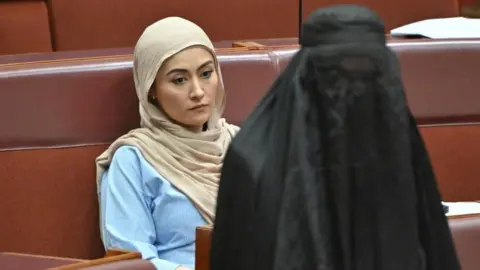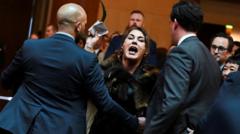
King Charles faced an unexpected protest during his visit to Australia when independent senator Lidia Thorpe interrupted an official address at Parliament House with shouts of "You are not my King." Her remarks followed a speech by the King and were meant to deliver a staunch message regarding Indigenous rights and sovereignty, asserting her belief that Charles represents a colonial legacy.
Thorpe, who identifies as an Aboriginal Australian, walked toward the stage while voicing her discontent, claiming, "This is not your land, you are not my King." The incident unfolded just as the King rejoined Queen Camilla after delivering a speech. She was eventually escorted away by security, but not before leaving a strong impression on both the audience and the visiting royals.
The royal couple's visit to Australia marks Charles' first since ascending to the throne in September 2022. While Thorpe's protest aimed to spotlight the plight of Australian Aboriginal and Torres Strait Islander communities, many in the public welcomed the King and Queen, seen as part of the cultural tapestry of Australia. Supporters mingled with flags waving under the Australian sun, eager to catch a glimpse of the royal family.
The senator's outburst was a critical reminder of Australia’s unresolved historical tensions with its Indigenous peoples. In her telling, Thorpe highlighted the necessity for the Australian Parliament to address and honor a treaty with the country's first inhabitants—something that remains a contentious topic in a nation rich in divergent histories.
Although the ceremony continued without acknowledging the heckling, the King's previous remarks on reconciliation had resonated with attendees. He spoke about the insights gained from Indigenous communities, reflecting on their strengths in navigating historical challenges.
As the royal couple engaged with the public after the ceremony, the atmosphere was mixed. While Thorpe's protest added weight to discussions surrounding the monarchy’s role in contemporary Australia, the King and Queen noted the warmth of the crowds who had come to see them—a testament to Charles' popularity amidst the broader debates about the future of the monarchy.
Thorpe's earlier remarks since entering the Senate, including descriptions of the former Queen as a "coloniser," inform her stance in ongoing discussions about Australia's colonial past. With debates about Australia's ties to the monarchy and potential moves toward republicanism emerging intermittently, the protest encapsulated a moment of reflection during a royal visit that had been anticipated for its ceremonial pomp.
Charles' brief visit, particularly poignant as he undergoes health treatments, drew attention not only for its royal connections but for the prevailing issues it inadvertently spotlighted. As conversations around Indigenous recognition and more profound societal reconciliation continue, Thorpe's powerful interruption serves as a reminder of the voices advocating for change in post-colonial Australia.