Ukrainian President Volodymyr Zelensky has condemned as terrorism a Russian drone attack on a crowded passenger train that local officials say killed at least five people and injured several others.
More than 200 people were on the train, according to officials, when one of the carriages was hit by a drone and two other drones exploded nearby, in Ukraine's northeastern Kharkiv region on Tuesday. Zelensky reported that 18 individuals were in the carriage at the time, stressing that there was no military justification for targeting civilians.
Although Russia has not publicly commented on the strike, it has intensified its drone and missile attacks on Ukraine’s civilian infrastructure during one of the harshest winters in recent years.
In a wider context, the southern port city of Odesa experienced heavy drone assaults resulting in three deaths and numerous injuries, with officials reporting significant damage to local energy infrastructure.
Amidst these attacks, millions across Ukraine have been left without essential services such as heating, electricity, and water.
Furthermore, the continuous violence follows recent diplomatic talks aimed at de-escalating the conflict, with key territorial issues remaining unresolved.
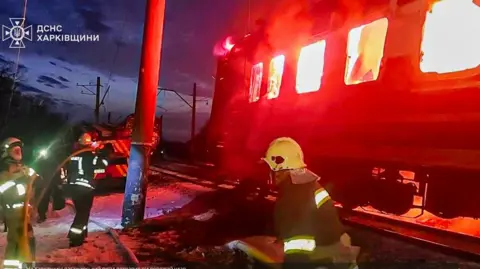
Pictures released by Ukraine's emergency services illustrated the aftermath of the devastating drone strike, showcasing the destruction of at least one carriage still ablaze post-attack.
This latest escalation raises urgent questions about the safety of civilians and the ongoing humanitarian crisis as the conflict approaches its fourth year.
More than 200 people were on the train, according to officials, when one of the carriages was hit by a drone and two other drones exploded nearby, in Ukraine's northeastern Kharkiv region on Tuesday. Zelensky reported that 18 individuals were in the carriage at the time, stressing that there was no military justification for targeting civilians.
Although Russia has not publicly commented on the strike, it has intensified its drone and missile attacks on Ukraine’s civilian infrastructure during one of the harshest winters in recent years.
In a wider context, the southern port city of Odesa experienced heavy drone assaults resulting in three deaths and numerous injuries, with officials reporting significant damage to local energy infrastructure.
Amidst these attacks, millions across Ukraine have been left without essential services such as heating, electricity, and water.
Furthermore, the continuous violence follows recent diplomatic talks aimed at de-escalating the conflict, with key territorial issues remaining unresolved.
Pictures released by Ukraine's emergency services illustrated the aftermath of the devastating drone strike, showcasing the destruction of at least one carriage still ablaze post-attack.
This latest escalation raises urgent questions about the safety of civilians and the ongoing humanitarian crisis as the conflict approaches its fourth year.