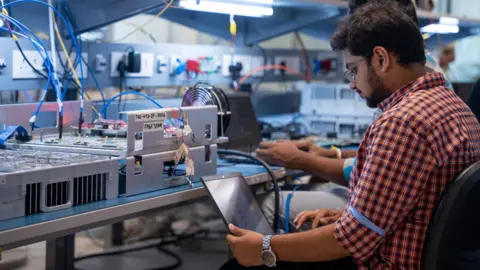
A reliable supply of computer chips is essential for Arnob Roy, the co-founder of Tejas Networks, a Bangalore-based company supplying equipment behind mobile phone networks and broadband connections. His company requires special telecom chips designed for massive data handling, crucial for ensuring network reliability and performance.
Tejas designs many of these chips in India, where it is estimated that 20% of the world's semiconductor engineers are based. Major global chip companies maintain their largest design centers in the country, which excels in chip design but lacks manufacturing facilities.
This was clearly highlighted during the Covid pandemic, when supply chains were disrupted globally. Arnob Roy noted the concentration of semiconductor manufacturing posed serious risks. This realization has led India to seek a self-sufficient semiconductor ecosystem.
The government, represented by figures like Amitesh Kumar Sinha from the Ministry of Electronics and Information Technology, is championing efforts to develop the sector by identifying competitive production areas and establishing a robust local industry.
India's strategy focuses on the third stage of chip production, known as Outsourced Semiconductor Assembly and Test (Osat), which includes the critical processes of assembly, testing, and packaging. Experts, like Ashok Chandak, note that several plants aimed at mass production are set to launch this year.
In Gujarat, Kaynes Semicon has become the first company supported by the Indian government to start semiconductor production, investing $260 million in a factory dedicated to assembling and testing chips. While they won't be producing the latest AI or mobile chips, they are focusing on the economically vital chips used in vehicles, telecom, and defense, suggesting that a solid domestic supply chain will take precedence over complex designs at the outset.
The transition to chip manufacturing is not merely about setting up production plants; it involves a significant cultural shift in discipline and training for the workforce. As the Tejas Networks CEO looks forward to bolstering local sourcing in the coming decade, the journey toward a robust semiconductor manufacturing base is just beginning. The future holds promise for India, aiming for a sustainable and self-reliant semiconductor industry.