Russian President Vladimir Putin has announced that Moscow is ready to provide uninterrupted shipments of fuel to India, despite pressure from the United States for Delhi to cease purchasing Russian oil.
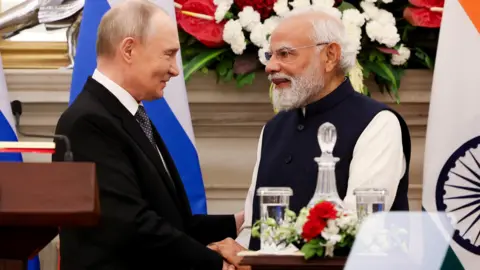
Speaking alongside Indian Prime Minister Narendra Modi in Delhi, Putin questioned the rationale behind punishing India for its oil purchases, while the US continues to buy nuclear fuel from Russia.
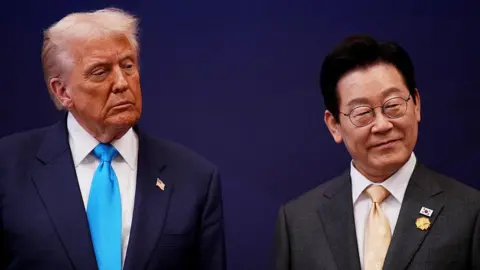
Former President Donald Trump had imposed 50% tariffs on various Indian products, claiming that India's continued Russian oil imports contribute to funding the war in Ukraine, an assertion that India has denied.
Putin's visit coincides with ongoing US negotiations with Russia and Ukraine aimed at reaching a peace settlement in the war.
During an interview with India Today, Putin expressed that Russia is seeking a peaceful solution to the war, cautioning that Ukraine must withdraw from the Donbas or face Russian occupation.
Either we liberate these territories by force, or Ukrainian troops will leave these territories, he stated.
Modi reiterated India's position of striving for peace, emphasizing that India's commitment to connectivity with Russia is substantial.
As relations between India and the US have deteriorated, Modi's comments came at a crucial juncture. Trump had initially set a 25% tariff on Indian imports, adding another 25% as a penalty for buying Russian oil, which India's government labeled as unfair, unjustified, and unreasonable.
In the interview, Putin defended India's rights, suggesting that if the US can procure fuel from Russia, India should have access to the same opportunities.
Despite a US ban on enriched uranium imports from Russia set in law, Russia remains America's largest supplier of nuclear reactor fuel.
During their briefing, Modi and Putin exchanged memorandums addressing mutual objectives, including trade and agriculture. Modi unveiled two new 30-day visa schemes for Russian tourists and announced the opening of two new Indian consulates in Russia.
Additionally, no significant defense agreements were forged, although agreements on shipbuilding and civil nuclear energy were confirmed, aiming for economic programs to extend through 2030.
Putin expressed optimism about increasing bilateral trade from $60 billion to $100 billion, underscoring that energy security is a vital aspect of the India-Russia relationship.
Amidst this backdrop, Indian firms have started reducing oil imports from Russia due to US sanctions. Nevertheless, Putin teased a flagship project for building India's largest nuclear power plant, indicating ongoing collaboration.
In summary, Putin and Modi aim to reposition their partnership towards advanced research and defense platforms, supporting a vision for a multipolar world, notably through the BRICS coalition that includes several developing nations.